It's the Environment, Stupid
Eldred Buck ·
Well of course, in these days of so called, 'realpolitik', apparently everyone only gets exercised about the price of eggs or gas, rather than the environment. Net Zero is now being thrown around as a playground taunt amongst, well science denying populists, who now claim the Overton window has permanently shifted. And so far, a lot of the usual suspects have gone along with this narrative and it's likely the reason that the opening of COP31 in Turkey today, is not at the top of our newsfeeds. You'd think they'd learn.
This is incredibly short sighted, because actually as anyone who looks at the issues will quickly conclude, it's plainly not a case of either one or the other when the 'economy' actually sits squarely within the 'environment' on a Venn diagram. Carbon emissions, water and climate change hasn't gone away just because the owners of social media have removed the hashtags. In fact, as the mid term elections in good ole Texas demonstrated, the tide has now turned, so to paraphrase Mr Buffett, best you check you've got your swimmers on before it's too late.
I say this because just over a mere four years ago, Kensington Mortgages issued what it called “the first labelled Green Bond from an UK ABS issuer”. It was a £750m bond, issued within the ICMA, Green Bond Principles Actually we at Houseprice.AI were a very small part of this, as we helped provide 3rd party verification of all the EPC ratings of the entire portfolio, nearly 2,000 homes across the UK. An independent review found the bond contributed to two of the UN's 17 Sustainable Development Goals, 7 (energy) and 11 (cities), which gets us neatly back to COP in Turkey today. As I said, I struggled to find it being reported in the press this morning, but here is some data that suggests this isn't going to remain a political Cinderella for much longer.
So let's look at the data, have we seen people abandon their concerns about the environment because now we're all so much more worried about the price of eggs, wokeism and border controls?
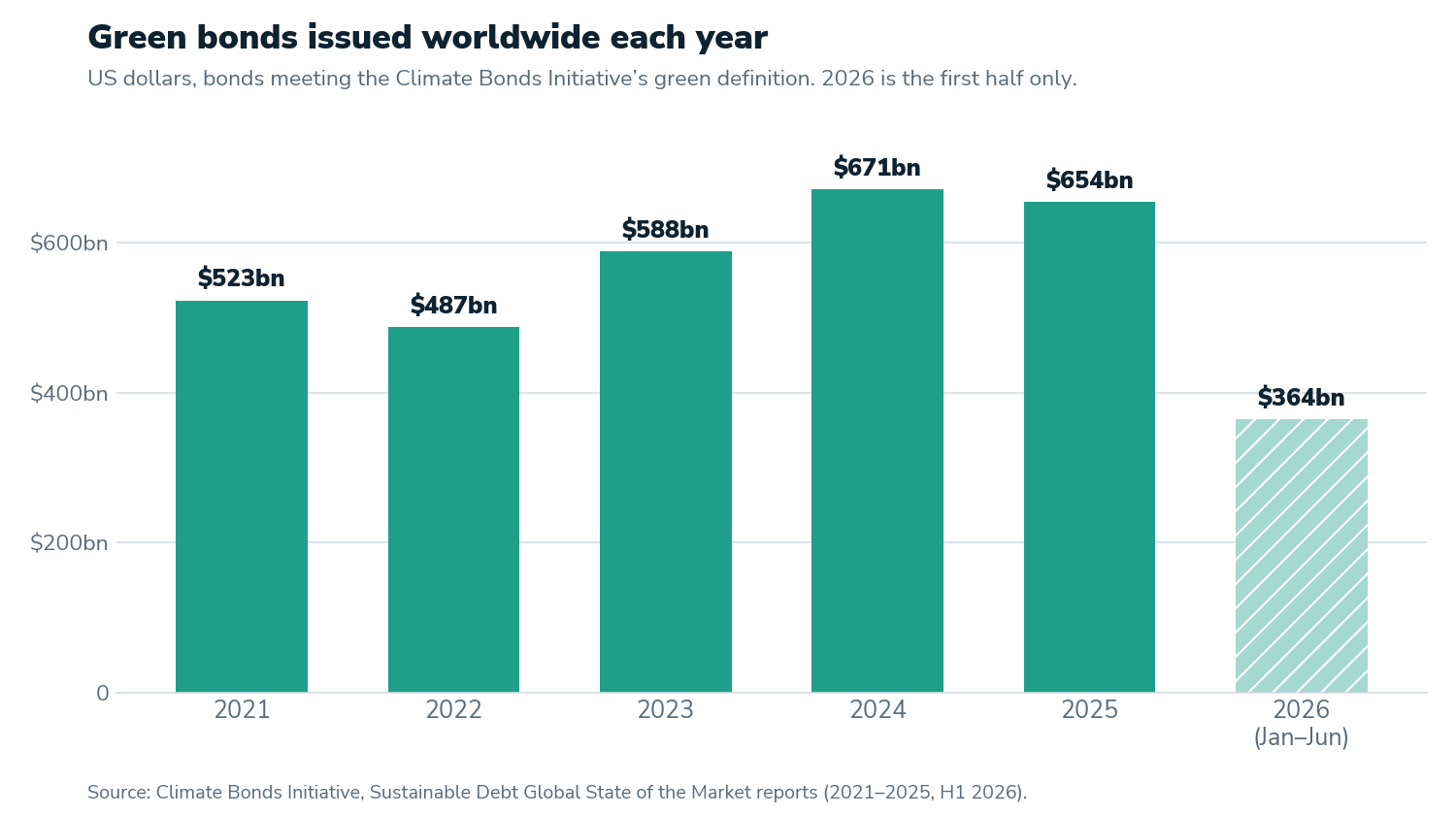
No. Green bond issuance hit a record $671bn in 2024, and the first half of 2026 was the second biggest half-year ever.
The green bond at issuance
| Measure | Green pool | Compared with |
|---|---|---|
| CO₂ per m² a year | 16 kg | 44 kg (initial loan pool) |
| CO₂ per home a year | 1.46 t | 4.32 t (UK average) |
| CO₂ for the whole pool a year | 2,678 t | 6,220 t (an equivalent standard pool) |
OK, so these are the carbon figures for Kensington's green pool in its first year. The green homes emitted about a third as much as the average home: 16 kg of CO₂ per m² against 44 kg for the initial loan pool, and 1.46 tonnes per home against 4.32. Across the pool that's 2,678 tonnes a year against 6,220 for an equivalent standard pool, about 3,500 tonnes a year less.
The catch: "green" was decided by the EPC letter, B or better, on the basis that B marked the lowest-carbon 15% of homes.
Is B still the top 15%?
| Homes | Rated A or B | Lowest-carbon 15% line | B homes inside it |
|---|---|---|---|
| England and Wales | 16.6% | 17.8 kg | 79% |
| Scotland | 17.7% | 19.0 kg | 75% |
| Great Britain | 16.7% | 17.9 kg | 79% |
Across 15.4 million homes in Great Britain with a valid certificate, A and B together are now 16.7% of homes, so the letter no longer picks out just the top 15%. More important, 1 in 5 B-rated homes isn't among the lowest-carbon 15% at all. It works the other way too: about 8% of the lowest-carbon homes are rated C, so a rule based on the letter leaves out some genuinely low-carbon homes. Interesting right?
Northern Ireland's certificates, now added, make the point more sharply: 21.1% of its homes are rated A or B, the highest in the UK, and only 73% of its B homes are among the lowest-carbon 15%. Across the whole United Kingdom, 15.7 million homes, it's 78%.
The reason is that the EPC letter classification measures running cost, not carbon. The two usually move together, but not always.
The direction of travel
| As at | Rated A or B | Lowest-carbon 15% line | B homes inside it |
|---|---|---|---|
| End 2021 | 16.0% | 21.0 kg | 88% |
| End 2023 | 17.4% | 21.0 kg | 85% |
| End 2025 | 17.8% | 20.0 kg | 80% |
| September 2026 | 17.7% | 19.0 kg | 75% |
Since the bond was issued, even more homes have been rated A or B (16.0% to 17.7% in Scotland), the carbon line has fallen (21 to 19 kg per m²), and the share of B homes truly in the lowest-carbon 15% has dropped from 88% to 75%. The letter and the carbon are drifting apart. England and Wales shows the same pattern over a longer period: A or B rose from 9.5% in 2014 to 14.6% now.
To be fair, part of the falling carbon line comes from newer certificates counting electricity as cleaner, not only from better homes. However that's still real, as the grid is cleaner, but some of it is a change in how carbon is counted.
It depends on the fuel
| B-rated homes heated by | Inside the lowest-carbon 15% |
|---|---|
| Mains gas | 81% |
| Other fuels | 73% |
| All B homes | 79% |
81% of gas-heated B homes are in the lowest-carbon 15%, but only 73% of those heated by other fuels (electricity, oil, LPG and others). A cost-based letter treats fuels differently from how carbon does, so the gap is largest off the gas network.
Green finance, and the UN's goal (SDG 7.3) of doubling the rate of energy-efficiency improvement by 2030, both need a measure that tracks carbon. Today's rule uses a cost letter as a stand-in, and that stand-in is getting less reliable. However a direct test of each home's carbon per m² is now possible across Great Britain, because certificates can be matched to every address which is what we are able to do for you along with a value based on these and many other drivers.
Actually ICMA recommends that issuers get independent external review to confirm their green status, so if you're looking for one, feel free to try ours here. You can value one home or thousands.
Glossary
COP: the Conference of the Parties to the UN Framework Convention on Climate Change, the yearly UN climate summit. COP31 is hosted by Türkiye, in Antalya.
EPC: an Energy Performance Certificate, needed when a UK home is built, sold or let. It rates the home from A (best) to G by its estimated running cost, and also states its CO₂ emissions. A certificate is valid for 10 years.
Green bond: a bond whose money goes only to projects with environmental benefits, reported against standards such as the ICMA Green Bond Principles.
Net Zero: removing as much greenhouse gas from the atmosphere as is emitted, so the total added is zero. The UK has a legal target to reach it by 2050.
RMBS: a residential mortgage-backed security, a bond paid from the repayments on a pool of home loans. A green RMBS uses the money for loans on energy-efficient homes.
SDG: the 17 Sustainable Development Goals, agreed by every UN member state in 2015 for 2030. Each has numbered targets, such as 7.3: double the rate of improvement in energy efficiency.